Made in the USA
Expert sizing support
National Safety Mirror

National Safety Mirror

Multi-Direction Visibility

Dome Safety Mirrors for Aisles, Hallways & Multi-Direction Intersections

Shop dome safety mirrors in full, half, quarter, and 270° corner formats to improve visibility at aisles, hallways, intersections, and parking areas. Compare acrylic vs polycarbonate lenses, backing options, and mounting styles to cover blind spots in retail, warehouses, schools, hospitals, and offices with 360° multi-direction visibility.

4

core dome formats

360°

possible central coverage

1

page to compare corner vs ceiling use

1Quarter, Half, Three-Quarter, And Full Dome Coverage
2Interior Blind-Spot Coverage For Multi-Direction Traffic
3Helpful In Retail, Schools, Warehouses, And Hallways

By application

Match the dome format to the blind spot

The same dome mirror page should guide both browsing and education: pick the traffic pattern first, then the exact product after the buyer understands the format.
01Selection path
Environment
Application
Hazard
Blind spot
Start with
Safety mirror

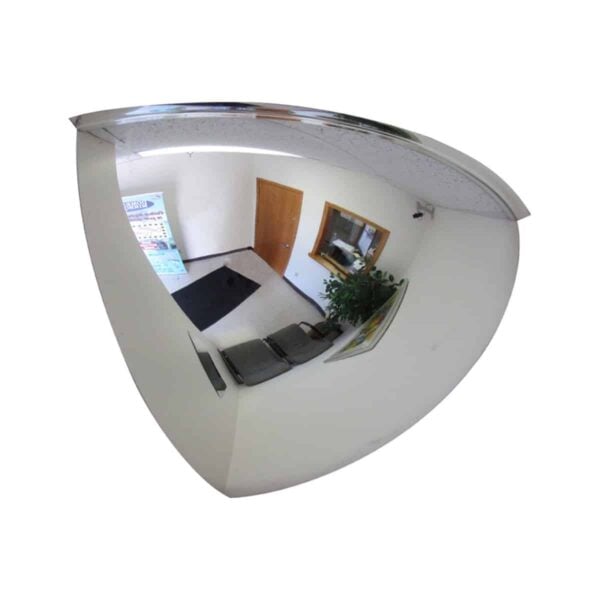
Quarter dome

Use at outside corners where two intersecting approaches need visibility from a compact mounted position.

02Selection path
Environment
Application
Hazard
Blind spot
Start with
Safety mirror

Half dome

A strong fit for aisle ends or wall-adjacent intersections where a wide interior field of view matters.

03Selection path
Environment
Application
Hazard
Blind spot
Start with
Safety mirror

Three-quarter dome

Useful where multiple approaches meet near a wall or ceiling transition and broader side coverage is needed.

04Selection path
Environment
Application
Hazard
Blind spot
Start with
Safety mirror

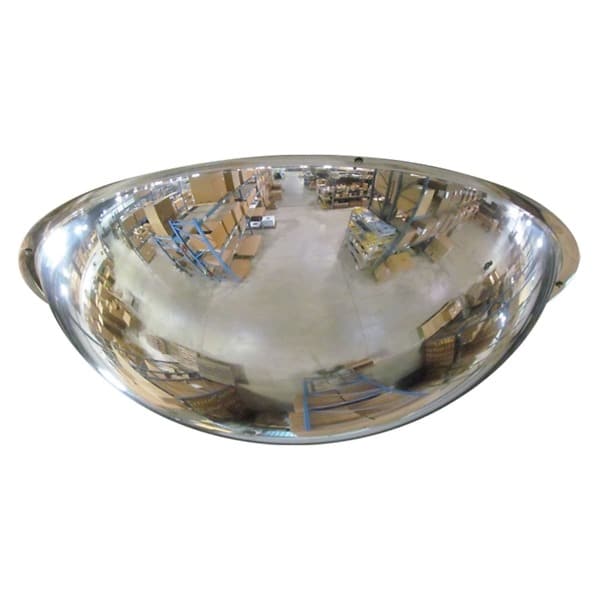
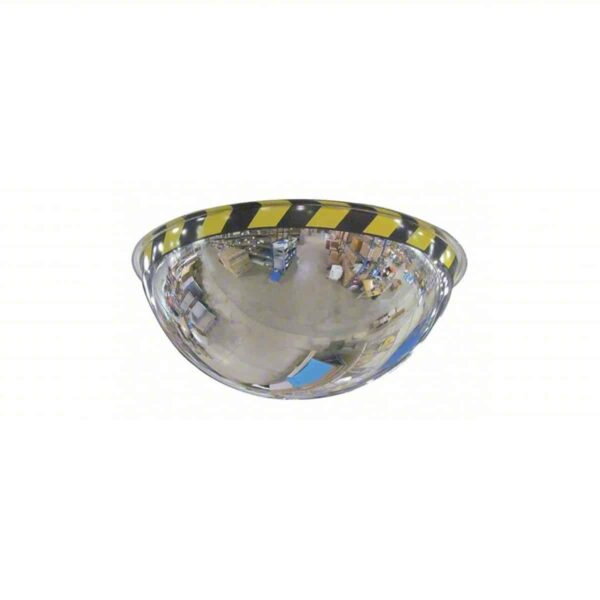
Full dome

Best when the mirror can be mounted overhead in the center of a multi-direction intersection.

Quick comparison

Corner-mounted dome coverage vs central overhead coverage

Before comparing part numbers, decide whether the dome format fits the traffic pattern.

Corner or wall-mounted domes

Best when mounting position is fixed

Common formats: Quarter, half, and three-quarter domes
Best for: Hallways, aisle ends, and corner traffic
Mounting logic: Attach to a corner, wall, or transition point
Buyer question: How many approach directions must be seen?

Central overhead domes

Best when visibility is needed in every direction

Common formats: Full domes mounted overhead
Best for: Four-way intersections and open interior crossings
Mounting logic: Suspend or fasten where the mirror sees the full zone
Buyer question: Is the intersection open enough for a central mount?

Selection guide

Dome Mirror Selection Guide

Start with the traffic pattern

Use quarter domes for two-direction corner approaches, half domes for wall or aisle-end visibility, three-quarter domes for T-intersections, and full domes for overhead four-way crossings.
Compare dome formats

Size by height and detail needed

A larger dome gives more usable detail at higher mount heights. Small aisle ends can use 18 or 24 inches; open warehouse, hospital, school, and retail intersections often need 32 inches or larger.
Read the sizing guide

Match material to impact risk

Acrylic works well for retail, offices, schools, and hospitals where clarity and cost matter. Polycarbonate is the better fit for warehouses, rough public spaces, jails, prisons, and vandalism-prone areas.
Compare lens materials

Confirm the mounting surface

Full domes need a centered ceiling or pendulum mount. Quarter, half, and three-quarter domes can mount at walls, corners, and transitions where overhead placement is not available.
Get placement help

Related guides

Guides for choosing the right mirror

These links keep this category connected to the matching guide, adjacent mirror family, or installation help page instead of forcing a broad restart.

Dome sizing guide

Use the sizing guide before choosing quarter, half, or full dome configurations.

7 products

showing all results

Free sizing help

Not sure which mirror is right for your space?

Send us a photo and an American-based specialist can usually recommend the exact model, size, and mount for your space — free, with no obligation.

Dome sizing reference

Dome Mirror Diameter By Coverage Area

Dome mirrors are sized by the diameter of the dome itself plus the height it's mounted at. The same dome size can cover a 20-foot intersection at 8 feet of mount height or a 30-foot intersection at 11 feet — placement matters as much as diameter.

Dome diameterRecommended mount heightBest for
18"7–8 ftSmall retail aisle ends, office corners, narrow stockrooms
24"8–10 ftStandard retail intersections, medium warehouse aisle corners, school hallways
32"10–12 ftOpen retail floors, warehouse three-way intersections, hospital corridors
36"–48"12–14 ftLarge warehouse four-way crossings, distribution-center hubs, school cafeterias and gymnasiums

Full domes need the most overhead clearance and a centered mount. Quarter, half, and three-quarter domes can sit at corners and wall transitions where ceiling mounts aren't practical.

Lens material

Acrylic vs Polycarbonate Dome Mirror

Acrylic dome

Approximately 17× the impact strength of glass

Best for: Retail floors, offices, corporate hallways, indoor schools, hospitals
Optical clarity: Excellent — closest to a true glass mirror
Weight: Lighter — easier ceiling mounting and less bracket strain
Price: Most economical option
Watch out for: Scratch and impact resistance is good but not extreme — not the right pick for warehouses with forklift traffic that can strike the dome

Polycarbonate dome

Approximately 250× the impact strength of glass

Best for: Warehouses with forklift traffic, schools with rough-handling risk, jails, prisons, vandalism-prone public spaces
Optical clarity: Very good — slightly softer than acrylic, still distortion-controlled
Weight: Heavier — verify ceiling structure and bracket rating
Price: Higher price, justified anywhere impact is realistic
Watch out for: Worth the upgrade in any installation with people moving fast or carrying tools — the lifetime cost is lower than replacing a cracked acrylic dome twice

Mounting position

Corner-Mounted vs Ceiling-Mounted Dome

Corner-mounted dome (quarter, half, three-quarter)

Mounts to a wall corner or wall-ceiling transition

Coverage: 90°–270° depending on dome share
Best for: Aisle ends, hallway corners, T-intersections, doorway approaches
Install complexity: Lower — fewer ceiling-load considerations
Watch out for: Pick the dome share that matches the intersection — a quarter dome at a four-way crossing leaves three blind directions

Ceiling-mounted full dome

Suspended or flush-mounted to ceiling at intersection center

Coverage: 360° — sees every direction at once
Best for: Four-way intersections, open retail floors, warehouse hub points, distribution-center crossings
Install complexity: Higher — confirm ceiling load rating and access for safe mounting
Watch out for: Mount height drives effective coverage radius. A 32" full dome at 12 ft sees a different floor area than the same dome at 9 ft

Dome Mirror Applications In Detail

Retail loss-prevention is the textbook use case for dome safety mirrors. A 32-inch full dome mounted overhead at the intersection of cosmetics, electronics, and pharmacy aisles gives staff 360-degree awareness across high-shrink zones. Quarter and half domes fill cashier-to-stockroom and fitting-room corridors where wall mounting is more practical than overhead mounting.

Warehouse safety mirrors are strongest when the dome format matches traffic flow. Mount a 36"-48" full dome at the center of a four-way forklift intersection to improve earlier awareness of people, carts, and equipment entering the crossing. If the hazard is one fixed corner rather than a four-way crossing, compare the dome against a convex safety mirror before choosing.

Schools, hospitals, and offices use dome mirrors at corridor intersections, stairwell approaches, and supervised areas where staff need multi-direction awareness without installing a camera. Acrylic dome mirrors are usually sufficient for these environments, while polycarbonate lenses fit rougher public spaces.

Jail, prison, and vandalism-risk installations skew toward polycarbonate construction because impact and tampering resistance becomes the primary spec. Use the dome mirror mounting guide and the dome sizing guide to confirm format, mount height, and coverage before ordering.

Dome Mirror Mounting Guides

Dome mirrors mount to ceilings, walls, and corners depending on the format. Each guide below covers hardware, placement, and step-by-step installation for that dome type and size range.
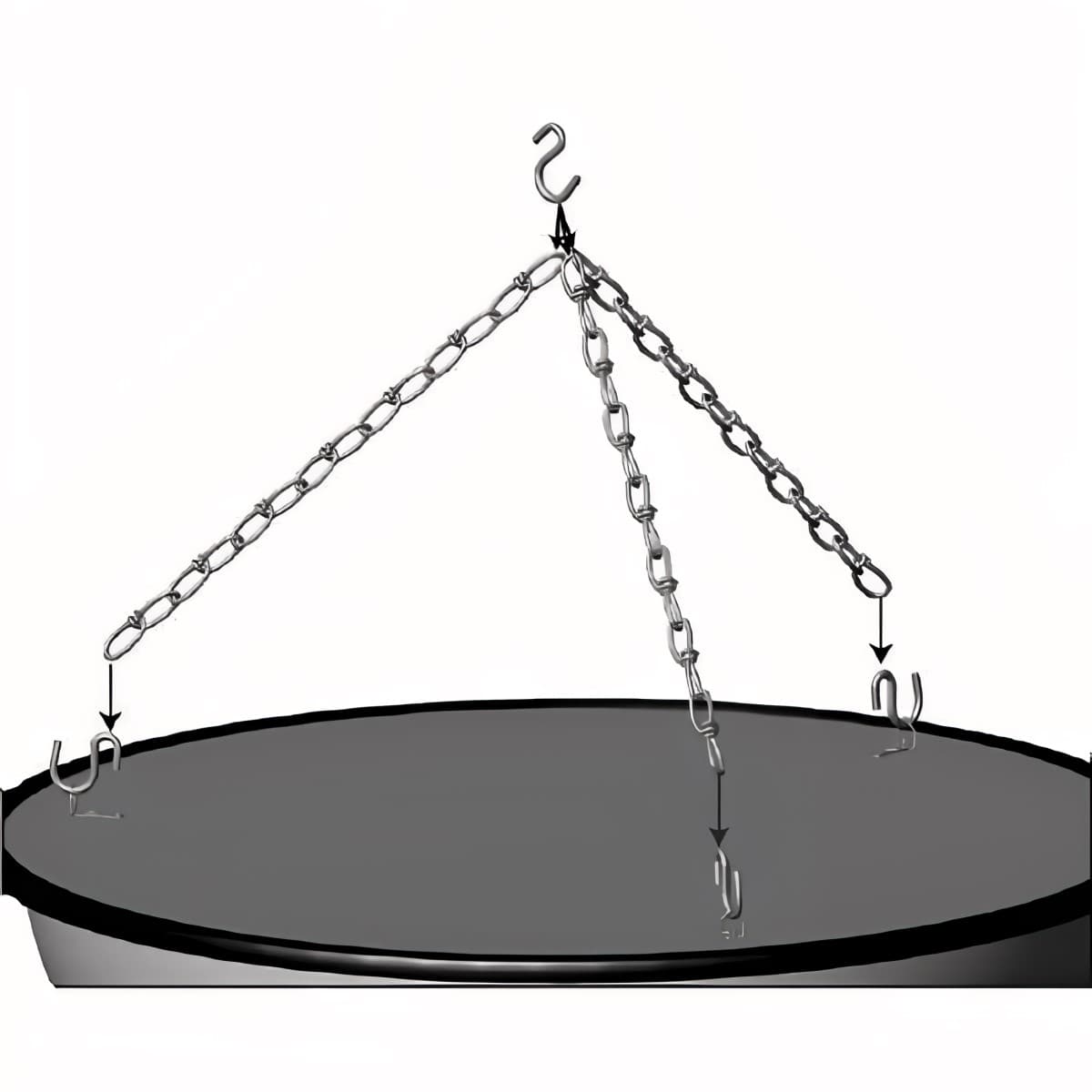
Full dome mirror with pendulum ceiling mount hardware

Full Dome — Pendulum / Ceiling Mount

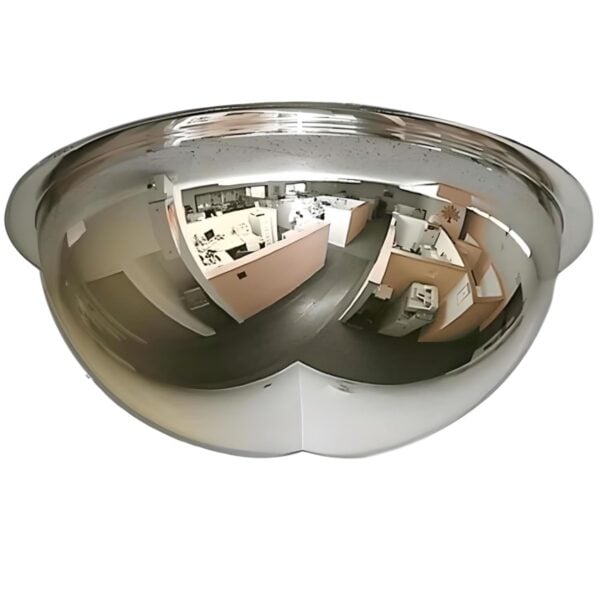
Full dome mirrors hang from the ceiling on a chain or pendulum mount. The mirror faces downward and provides 360° coverage of the area below. Use this guide for ceiling grid, drop-ceiling, and open-joist installations.
Large full dome mirror pendulum mount

Full Dome — Larger Sizes

Larger full domes (32, 36, and 48 inch) use heavier mounting hardware. This guide covers the additional support requirements for larger ceiling spans and higher ceilings.

Half & Quarter Dome — Wall and Corner Mount

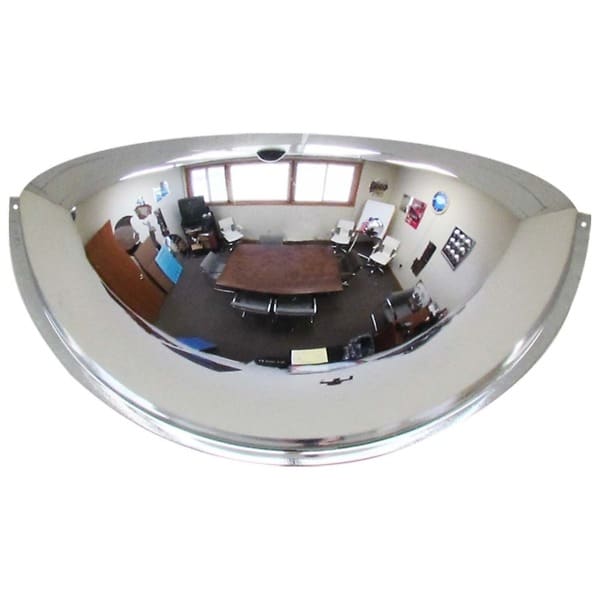
Half domes mount flat against a wall for 180° coverage. Quarter domes fit into a corner junction for 90° coverage. Both formats use a flush wall bracket and are common at aisle ends, hallway intersections, and retail checkout areas.

Half & Quarter Dome — Larger Sizes

Larger half and quarter domes (32, 36, and 48 inch) require heavier wall anchors. This guide covers the additional fastener and support requirements for larger format installations.

270° Corner Dome

The 270° dome covers three-quarter visibility from a corner mount — more than a half dome but without the full 360° ceiling requirement. Used at T-intersections, three-way hallway junctions, and open-plan corners.

Dome with Dust Cover

Dust covers protect the mirror surface in manufacturing, food processing, and other environments with airborne particles. Installation adds a clear acrylic cover over the dome face.

Buying questions

Dome Mirror Frequently Asked Questions

The questions our sizing team answers most often.
When should I choose a dome mirror instead of a standard convex mirror?+
Choose a dome mirror when visibility is needed from multiple directions at the same intersection — three or four converging paths, or two paths plus an overhead approach. A standard convex mirror covers one main viewing angle very well; a dome covers multiple angles from a single mount.
What's the difference between quarter, half, three-quarter, and full dome mirrors?+
Quarter domes (90° coverage) fit at outside corners. Half domes (180° coverage) work at wall-adjacent T-intersections. Three-quarter domes (270° coverage) suit transitions where three approach directions need coverage from a wall-mounted position. Full domes (360° coverage) are best mounted overhead at four-way intersections.
What size dome mirror do I need?+
Dome size depends on both diameter and mount height. As a starting point: 18" domes cover small aisle ends, 24" covers standard retail intersections, 32" handles open retail floors and three-way warehouse intersections, and 36"–48" covers large four-way warehouse crossings and distribution-center hubs.
Acrylic or polycarbonate dome — which is better?+
Acrylic is roughly 17 times the impact strength of glass and is the right call for retail floors, offices, schools, and hospitals where impact risk is low. Polycarbonate is approximately 250 times the impact strength of glass and is the safer choice for warehouses with forklift traffic, jails and prisons, and any vandalism-prone public space.
Are dome mirrors only for indoor use?+
Most dome mirror applications are indoor — retail, warehouse, school, hospital, office. Outdoor dome installations exist but are uncommon; for outdoor traffic and driveway visibility, a polycarbonate convex mirror on a telescoping bracket is usually the better fit.
Are National Safety Mirror dome mirrors made in the USA?+
Yes. NSM partners with family-owned manufacturing shops in the Midwestern United States and ships handcrafted-to-order rather than from warehouse stock. Lead times stay short and quality stays consistent across production runs.

Need help choosing?

Tell NSM where the blind spot is and how traffic moves through it

Tell us whether the intersection is corner-mounted, wall-adjacent, or open overhead, and NSM can usually narrow the right dome style.